100 McMillan Drive Suite H Spartanburg, SC
  UPSTATE SPEEDWAY
  • Home
  • About
  • Rules
  • Schedule
  • Homeschool
  • Car/Tire Building
  • Lingo
  • Contact
  • MAP
  • Costs
  • Store
  • Blog
  • Drag Racing
  • Category
  • Wall of Fame
  • History of Slots
  • Classes of Slot Cars

SLOT CAR WALL OF FAME

As with any sport, Slot Car racing has seen various men and women who have made significant contributions and left a lasting mark on Slot Car racing. Some were racers, others were track owners and still others were inventors and innovators. While there are many more than are mentioned here, you will find on this Wall of Fame a few of those most recognized for their impact and often for their sacrifice to preserve Slot Car racing and help it to prosper.

    CAndidate Submission

    Please provide YOUR contact information in the appropriate locations. In the Comments, provide the name of your nominee and a brief narrative to justify the submission. Dates of accomplishments and significant contributions to Slot Car racing are key.
Submit

DRIVERS

Picture
John Cukras 1948-2020- West Coast "pro driver" immortalized in the famous Leon Mandel Car & Driver Slot Racing article.  Responsible for the aforementioned Mura motor development and with the winning of a race in Texas that had whole slot racing world began to shift to using  Parma (Russkit) pistol grip controllers still in use to this day as the race controller of choice.  Went on to have a career in the development of HO cars in later years.

Mike Steube- Ultimate West Coast backed up by the winding and fabricating capabilities of his Dad-Bill

Phillippe de Lespinay-Eternal champion of the slot racing hobby. Has had much success in a variety of hobbies from motor cycle racing, model kit design and documentation, design of innovative production and scratch built slot racing cars and controllers, importer of 1/1 race cars and wheels, 1/1 safety equipment and much much more. Wrote two books on the hobby and started a major blog on the subject on the internet. Came to America not speaking the language, the clothes on his back and suitcase, and the money in his pocket and became the personification of living the American dream as the years passed.

Luiz "Gugu" Bernadino - Born in Arujá, and residing in São Paulo, Brazil, Luiz. An international driver and winner of the 1989, 1991, 1992, 1995 Euro 24; the 2006, Pro 27, the 2007 Spec 15, 2010 GPR 27, 2011 F1 32, 2013 EURO 32, OMO; 2017 F1 32; and the 2017 Geezer GRP 27. In addition to his many international victories, he is perhaps best known for ​his stories and pranks over the years that have broken the tension and serious demeanor of many a race weekend.

Earl Campbell - The first sub 4 second lap was run at the USRA race at "Speed & Sport" in August of 1971. In that era everyone ran brass & wire or steel center sections. Monty was under the J&M products team name but became "Big O" pretty near the same time as a sub-business to J&M. Pepe won that race with Steube horsepower and a good run, Earl came in second with Dave Fortner from Tucson AZ nipping at the back of Earls car.

Greg Gilbert - Winer of the 2007 USRA National Championship at  Keystone Raceway, Palmyra, PA running on a  Gerding Flat Track and the 2009 1/32 USRA National Championship held at the Mid-America Raceway, Montgomery, IL running on the Gerding "Midwest Monster"
Picture
Chris Chan - (1949-2013) Chris Chan  was a long time friend and associate of Team Associated.  As a team driver he won the first National Championship title at the 1971 ROAR Nationals.  Through his company, Chan Design, Chris produced many magazine ads, product art, trade show art,  and box designs from 1972 to 1995.  The outstanding quality of his work contributed greatly to the success of the Associated Electrics RC12 and RC10 product lines.
 
Chris was a pioneer of model car racing.  Starting with HO scale cars in 1959, he moved on to 1:32 scale and 1:24 scale while in high school, and became the technical and feature writer for Model Car Science magazine for three years.  Retiring from professional slot racing in 1967, he went to the Art Center College of Design to study advertising and graphic design.  Chris switched his hobby to RC cars, and started his own advertising agency, Chan Design.  In 1973, Chris founded the RC magazine “Racing Circuits”, which reported on RC racing activities for the remainder of that decade.
 
After 30 years in the Ad business, Chris returned to his original passion, slot racing.  He converted his office suite into a raceway,  and hosted races for slot racing fans from around the country.

Picture
Greg Gilbert: 2-time ISRA 2010 World Champion, this is against all of the best racers in the World, not just the USA, he even beat Paul Gawronski that year.
Made the Finals 8 times in 8 races during the 2 ISRA World Championships he attended, again against the best in the World!
Countless USRA National titles, again including several wins over Paul Gawronski and other great U.S. (and international) drivers.

Picture
Martin Gramann ( 1951 - 2009)  Martin Gramann of Vienna Austria was a former F3 racer. Seriously handicapped after a racing accident he could even no longer use his fingers but was one of the best all-time wing car racers, the first European who  succeeded to beat all American pros at the 1995 USRA Nats. He also won the 1994 Wing Car Worlds, the 1989 and 1994 European G7 Wing Car Championship, and he won nearly all  G27 wing car races he entered. From 1981 thru 1999 Martin Gramann was a professional wing car racer, having created a splendid wing car racing center in Vienna. There he installed
 in 1990 the most professional Blue King track on the European continent. He also commercialized several Blue King tracks which were shipped to the Arabian Emirates and Saudi-
Arabia. In 1998, with pain in his hart, he had to close the Vienna Slot-Racing Centre as a couple of members refused to help him paying the rent of the building. The splendid Vienna  Blue King was then sold to the SRC Zlin of Jiri Micek jr. There the track was in use until early 2008 when the Czechs, at their turn, could no longer pay the rent of their location.
The track was sold to a new club in Vienna where it was completely reconstructed. Together with Bernd Möbus (D), Hans-Peter Sutter (CH) and Vlado Okali (SVK), Gramann was one of  the leaders of all wing car racing in Europe. Möbus won three times the European G7 European Championship and stepped out in 1988 to start the distribution of R/C cars of Kyosho in  Germany. When Hans-Peter Sutter passed away Gramann and Okali were the two remaining leaders of wing car racing in Europe. In 1999 Gramann decided to stop active slot-racing
but was seen at several occasions as spectator at international races. Although his handicap made that he was nearly unable to drive model cars, he and Bernd Möbus finished second at the 1985 old-timer Worlds in the Antwerp Crest Hotel. In 1994 he still entered the IMCA Model Car Worlds with NASCAR cars at Darmstadt, but he became ill during the race and had to retire.

Paul Gawronski: Nicknamed "The G-Man"
A listing of Gawronski's achievements includes:
  • 4-time ISRA World Champion, this is against all of the best racers in the World, not just the USA!
  • Made at least one Final in 13 out of 15 ISRA World Championships, again against the best in the World!
  • Over 15 national titles since 1994 and a 1997 world championship.
  • More than 50 USRA National titles, more than any racer in USRA history to date. 
  •  
Picture
Monty Lewis Ohren (1954-2010)  Monty's first experience with slot cars was in 1964, following a magazine article in "Popular Mechanics". Always an avid reader, he made it a point to thoroughly read Car Model, Model Car Racing and all similar publications, committing race reports and technical data to memory.

Monty first built a scratchbuilt car in 1965. He started competing in SoCal USRA events beginning in 1969. His racing developed and 1970 saw him competing in the "Semi-Pro" class, a year later winning the Mura Southwest Regional Semi-Pro Championship in 1971.

Another milestone was in September 1971 when Monty built the car driven by Earl Campbell that did the first ever sub 4 second lap on a King track. In 1973 Monty decided to join the slotcar industry full time, and purchased a ½ share in a raceway with "Big Jim" Greenemeyer (who is these days known as a 1/10th scale R/C motor guru, in a perverse case of parallel personal evolution), and in 1974 he bought out Jim's share in the raceway, which he then ran through to 1980, culminating with hosting the World Championship of 1980. Monty raced in this event and made the Pro Main.

After that, Monty then retired to a "normal" life, but decided to return to slot car racing in 1989, winning his first SoCal race in his first start back in January 1989. He raced for a number of years taking the SoCal Group 7 championship in 1992, 1993, 1994 and 1996, winning the Western States Group 7 Championship race in 1996, after taking 2nd in 1991 and 3rd in 1995. At this time a new form of racing started, 1/24th Eurosport, and Monty joined the racing at the ground level, winning the SoCal series in 1995, 1996 and 1997, along with the 1/32nd Eurosport series in 1995 and 1996.

In 1998 Monty founded Best 'O' The West (BOW), building high quality slot racing motors and products, and even some tracks. He continues to grow and run the company to this day, being the winning builder and/or balancer for 16 of the last 20 ceramic class races at USRA Div 2 Nats. Monty has also had much success here in the US in regional series, and around the world in such countries as France, Belgium, The Phillippines, Canada and Sweden.

Picture
Paul Pfeiffer - After 6 years of  teaching Jr. High School, Pfeiffer resigned and went to work for Joel Montague at Camen. In 1981, he left Camen and returned to Wisconsin and began building chassis, winning 3 consecutive Pro Group 7 World Championships (1980 – Sylmar CA, 1982 – Uden Holland, 1984 – Elmsford NY) and 3 consecutive USRA Pro Group 7 Championships (1981 – Milwaukee WI, 1982 – Inman SC, 1983 – Centerville OH).
Pfeiffer  started Alpha Products in 1983 with only one product, the 3/32 x 13/16 magnesium hub orange tires. Alpha eventually became a leading producer of slot tires (over a million pair sold).

Picture
Howie Ursaner - Ultimate East Coast racer who was a "pro" for Cobra products.  He was contracted to Cobra Slot Car Products starting in July 1967 for  $5,200 a year plus expenses. That is equivalent to over $40,000 a year in year 2020 dollars.  
​Howie Ursaner is considered by many to be one of the most, if not the most successful pro-racer of the classic era. Ursaner built car for Ray Hoy of Model Car & Science. The body was made from painted clear plastic but still features a train type motor, in this case probably a Pittman. Ursaner was a professional slot car racer by the age of 14 driving for teams Cobra and Russkit.
At age 14, Howie won the biggest race of the classic period with this Bob Emott built, Pittman 196-powered aluminum and brass car, on which the body could be switched from a sports car to an open-wheel GP in a matter of seconds. For his efforts, Howie won a full-size Formula III racing car, which he was too young to drive! Howie won a second car, an Austin-Healy 3000, in another classic slot car race. He never collected either car...

​
Picked by the famous Team Russkit, Howie switched for serious money and Team Cobra in 1967 and raced with driving partner Sandy Gross for the New York-based concern until he left the sport at the top in 1971.

Reflections from Ursaner: "
When i joined Team Russkit with Sandy Gross, NO ONE used the pistol grip controller except Team Russkit. Jim Russell believed in it and no one else did. Sandy and I had to switch over to the pistol  to be on the team and we were not excited about it. It turned out that we loved it and started racing and winning with it. It wasn't long before the whole racing  world  adopted it. It was all Team Russkit that made it happen and no one else.    I got a contract with Cobra Slot Car Products to race slot cars. It also included an expense account and they paid for basically all of my expenses including gas in my 66 427 Corvette that i bought with slot car money . I later got Sandy Gross a contract to race. We are the only 2 people to ever get a contract to race a slot car . we had no other duties but to race and make some promotional appearances touring the country. All other pros were given parts or other minor sponsorships." 

Tony P. Wells - Wells was active in racing and race organizing. He was the manager of Nutley Raceway, a co-founder of Retro East racing.
He holds the American King track single lap world record holder & 40 minute total lap record group 7
Team Nutley, Teamtonyp, team Hi-Pro, team checkpoint,, team Nutley driver
national championships chassis builder
First IM Nationals Champion
Arco Champion
Car Model Magazine Series Amateur Champion
2016 ORS Anglewinder Constructors Championship)
designed for team Nutley and Parma international, Lucas bodies and associated
Eastern States Winner
Ron Granlee Pro Series winner
Picture
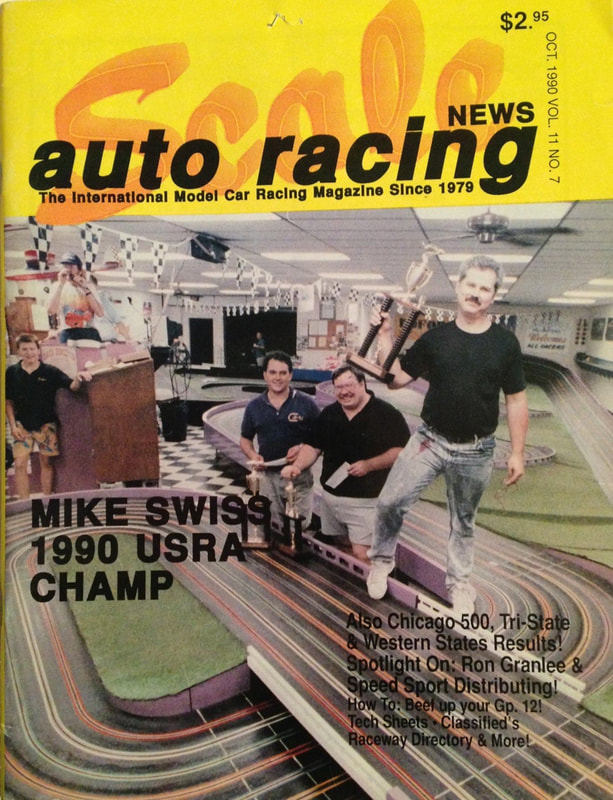
Mike Swiss - Mike began his lifetime engagement in slot car racing in the 1960s and 70s in Chicago.  Taking public transportation before he could drive, he cut his teeth at such ground-zero, iconic tracks as Hinsdale Raceway’s storied AMCR Blue King and Moto-Rama, in Forest Park, IL and their seminal custom Formica layouts.  Mike worked behind the counter in the heart of Chicago’s “Loop” business district at Hobby Service and Supply as a teenager and was a regular participant at the storied Chicago Hobby Show that attracted attendees from around the world every year.As Mike began travelling around the Midwest in the 1980s, he rose through the USRA group levels and emerged as one of the top pros.  Mike was constantly fabricating new innovations, and when he unveiled the first perimeter chassis in the mid-1980s, the pro racing world would never look back.

In 1985, in Pasadena, TX, Mike made the first of many pro mains at the USRA United States National Championship Race.  By 1988 there would be no stopping him at the “Nats” in Kent, WA at Speedway & Hobby Too as he topped the field to win his first pro national championship.  In that same year, Mike took the international wing racing competition winning the World Championship at Grand Raceway in Broadview, IL.

As an established pro running for Koford Engineering, where he now worked as the General Manager, Mike continued winning races in the U.S. and abroad.  The 1990 racing season brought new levels of excitement, as for the first time, the USRA Nats would be held on the legendary AMCR Sovereign – the “Purple Mile” at Georgia Hobby Center in Fayetteville, GA.  In what would be the very last time that an AMCR track was used at the USRA Nats, one could argue that the pro main featured the best line-up of racers ever assembled throughout the span of time, including, Joel Montague, Paul Pfieffer, P.A. Watson, Jon Laster and Fred Hood.  In fact, the pro main featured six former and future national champions that would collect fourteen Group 7 titles between them!

Mike won his second USRA National Championship that day with a focused and compelling run.  One only need view the cover of the October 1990 issue of Scale Auto Racing News (included below) to see Mike on top of that beautiful track, and indeed on top of the slot car world.

At the World Championship race later that year, Mike doubled down and won again at American Hobbies in Orlando, FL.  This time, beating another elite main field that featured past and future champions, Paul Pfeiffer, Joel Montague, Paul Pederson and Jon Laster.  It must be stated that to this day, Mike is the only racer to win both the USRA Nats and the World Championship in the same year – TWICE.

Mike continued his winning ways on and off the track until his last appearance in the pro main at the USRA Nats in 2004 where he placed second.  This was his twelfth USRA Nats main and his ninth podium. 

As he retired from his active pro racing days, these nine podiums at the Nats were most all-time.  Additionally, at the Worlds, he made eight mains and finished on the podium five times.  Mike set world records on multiple occasions throughout the years and the variety of tracks, for both single lap times and lap totals.  It must be noted that Mike also raced in the HO scale in the 1970s as well, performing quite well at the pro level in HOPRA races in both Illinois and Indiana against some of the top names of the day.  Only a very few racers have had true success in both scales within the USRA and the HOPRA ranks, and Mike Swiss is one of them.

He transitioned from his ground-breaking work at Koford to a successful raceway owner at multiple locations around the suburbs of Chicago, twice hosting the USRA Nations himself.  He has been a force behind the emergence of the retro racing scene and beyond advocating for this extremely popular racing class, Mike has continued his innovations in design and construction.

Mike Swiss was one of the very best pro racers of his era.  He brought the necessary intensity, discipline and passion to all aspects of his efforts.  His sterling resume goes far beyond his on-track success, from his business acumen at Koford, to his Raceway ownership(s).

Picture

TRACKs and track OWNERS

Picture
Bob Haines 1934-2018 ​/REH Distributing - Bob owned (Cincinnati Slot Racing Center) one of the 8-12 raceways that were in the Cincinnati area in the mid-60's.  He had been a typewriter repair person for IBM.  He and some friends took an interest in the early days of slot racing and thought a commercial raceway would take hold.  So they built a built a simple “L” shaped figure 8 track using bonus money he received from IBM for a product improvement idea he submitted.  Copper tape routed track with coin timers that were used in laundromats of the era-insert a dime or a quarter for the time desired.

At the beginning boom of the hobby a major toy distributor in town (I believe they were named Elmex) carried slot car stuff, but it really didn't fit into their overall long term plan and they decided to wind that segment of their business down.  Too much obsolescence for a constantly morphing hobby. Sound familiar?  In this void Bob saw opportunity.  He started distributing to some of the local raceways and gradually expanded out of the Cincinnati area.  Basically the market was the Midwest, East Coast (some), South and some Canada.  He went to all big races in a red Ford Econoline Van with the company name proudly and professionally painted on the side.  It was an iconic symbol of REH and slot racing in general at the time.
Haines was involved in all scales of slot racing from 1963 on  and founded REH Distributing in 1964 in Cincinnati, OH. He evolved from a hobbyist, to track owner to distributor.

Picture
Francesco (Frank aka. Buzz) Perri (November 9, 1935 - May 12, 2021)
​

Buzz-A-Rama ( 69 Church Ave, Brooklyn, NY 11218) was opened in 1965 and remained in continuous operations 56 years until Buzz and his wife Dolores passed away in April and May or 2021. 
Arguably the most visible and most interviewed slot car owner ever. From numerous local newspaper special interest stories to the national media such as the Today Show, Buzz always stood up and told the story of Slot Car racing in his beloved Brooklyn, NY. 
Buzz-A-Rama remained a place where the past met the present. Much of the timing equipment and power supplies as well as the tracks were vintage American Model Raceway brands. Regular races were held on authentic tracks:
  • Yellow Windsor
  • Black Regal
  • Blue King
  • Orange Monarch
  • Buzz also had the he only yellow Emperor known to still exist. It was unassembled in his legendary basement.
Hosted the World National Championship Slot Car race September 1-2, 1979. November 9, 1935

Picture
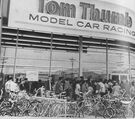
Tom Thumb Hobbies was founded by Ralph “MAC” and Gracia McMasters in 1963. Originally known as Mac’s Train Repair. The name was changed to Mac’s Tom Thumb Raceway And Hobbies in 1965 when the first  AMCR slot car tracks were installed. The initial track inventory was an 80 ft AMCR Yellow Windsor , a 100 ft AMCR Orange Monarch, and an Aurora Orange HO Tub track. Later in, 1966,  the Windsor was sold and replaced in with the Blue King which remains at Tom Thumbs today (2021).
Mac was a chief mechanic for the REA Express company and Gracia was a nurse and lab technician. MAC was looking for a career change and after giving his oldest son Mike an American Flyer train set for his 3rd birthday in 1959 the stage was set. The train business was going well when MAC saw an article about the newest craze known as Slot Car Racing. It was love at first sight. After 3 years of planning which included building a 7500 Sq Ft building, most of which he did himself, the business opened. Open 9:00 am to 9:00 pm 6 days a week (it wasn’t legal to be open on Sunday at the time) there was seldom a lane open for racing.
Their oldest son Mike stayed with the business from the start taking over management in early 1980.  Gracia worked everyday day until her passing in 1991. MAC was still working every day and doing almost all maintenance himself, including roof and HVAC repair, up until his passing in 2006 at the age of 84. Mike continues to operate the full line hobby store and raceway alongside his wife Cindy.
The almost six-decade saga has been extremely rewarding in all ways. When a multi generation customer stops in and describes how much our store meant to him and his friends and recalls memories he says he will never forget it reminds us how blessed we are.

OTHER CLAIMS TO FAME

Picture
Jerry Kulich - Began JK Products in 1987 after immigrating to the US in 1980. While at JK Products Kulich provided quality parts and innovative advancements all while promoting Slot Car racing at tracks he himself owned and operated. JK motors and Chassis became an industry standard and JK parts could be found on virtually every slot car track and inventory of Slot Car tracks around the world.​

Ken Macdowell (1934-2010)​   In 1964 Ken MacDowell opened Parma Model Raceway in Ohio. MacDowell had only been introduced to slot cars a year earlier through a Strombecker home set. From there MacDowell went basement racing at a local club. He was smitten by the fast growing hobby and decided to open up his own raceway. An amateur drag racer during his youth he built his business into Parma International, a manufacture and distributor of slot cars, parts and accessories. Some of his trademark products include the Parma controller, WOMP cars and starter sets, flexi steel chassis and the Parma 16D motor.  Parma International is credited by some as single handedly saving the hobby during the dark years of the 70's.
Picture
Frederick Francis, (Bertram)   (1919–1998) Launched in 1957, Scalextric was the brain child of Bertram ‘Fred’ Francis, the talented inventor behind a range of mechanical tin toys. The first Scalextric cars were tin too and powered by a small electric motor, instead of the more common clockwork cars of the time. This new toy took off and by 1958 Francis had sold his idea to Triang, who looked to invest. Triang produced newer cars in plastic and the range of vehicles offered started to expand.
The very first car released by Scalextric in 1957 was the Maserati 250F, then the car to have in Grand Prix racing with Juan Manuel Fangio scoring his legendary final win in one at the 1957 German Grand Prix. In this race he overcome a 48 second deficit in just 22 laps and broke the lap record 10 times in one race. The very first Scalextric set featured two of these cars and perfectly captured both the glamour and beauty of motor racing cars of the period. The 250F was phased out of F1 racing shortly afterwards, but remains one of the most iconic and beautiful F1 cars of all time, a shining testament to the bravery of the early F1 World Championship competitors.

INVENTORS AND CREATORS

Picture
Bob Rule/Champion-Took his expertise in hobby promotion in the world of yo-yo's and applied it to slot racing at a time when it needed it the most.

Ron Mura - Mura Products-manufacturer lead the transition from Mabuchi "rewind" to motors designed and fabricated for the American racing scene

Roy Moody - The late Roy Moody was a mechanical genius, one who most often was thinking outside the envelope. Moody invented the modern angle-winder drive system that allowed a much improved handling over conventional inline or sidewinder chassis. He was also along with Jack E. Caveney, a co-inventor of the one-piece cable tie patented in August 1987.
Picture
Jim Russel 1920-2010/Russkit-early visionary of the potential the hobby had.  Russkit became the standard controller format (pistol grip) still used to this day and morphed over to be the same in R/C racing.

Russell was a business consultant in Los Angeles and had been dabbling with the new hobby since 1959.
 That year, 34 year old Jim Russell was looking for something to do on a weekend when a friend introduced him to a novel new hobby called slot car racing. Russ, as everyone calls him, was hooked. A visit to Hollywood Raceway, one of the nation's first commercial slot racing centers, inspired him and friend John Tyler, a hobby shop owner, to build a multi-lane routed track in his den. They used Strombecker cars, modified for higher performance. This was an instant success in the neighborhood, and the need for better parts became obvious. A small accident that dropped some Behr varnish over one of his models convinced Russell to market the polyurethane coating to protect the finish on slot car bodies, so he founded Russkit in November 1963.

Picture
Oscar Koveleski (1932-2020) A racer from the 1950s and 1960s whose life's passion became model cars and airplanes, Koveleski is likely best known through his Auto World model car, HO-scale models, and slot car business that he formed in 1958 in a friend's basement in Scranton, Pa., He funded it by cashing in a $300 life insurance policy.
"Auto World started not as a store but a mail order company we operated out of my friend Bob 'Smitty' Smith's basement," Koveleski said in an interview posted to the Auto World website. "Because of our aggressiveness and knowledge, we became important to real enthusiasts and manufacturers. My wife and I did the first catalogs on the kitchen table and ironing board. Our first two of four kids got to like licking the glue on the stamps!
"Our first ad cost $55 (send certified check, as there were no credit cards or quick banking then) in Hot Rod magazine for a Monogram Dragster. It worked. Well, kind of. At a $1 or so a kit you have to sell a lot of them. I had a recurring problem with a bad back I injured several times (once in the Army as a passenger in a Jeep rollover), which had me flat out in bed off and on for years. But careful exercise and effort got rid of it but in the meantime 'Mail Order' was something I could do in or out of bed."
On the track, he joined the Philadelphia Region of the SCCA at 18. His first win came in a 1951 SCCA Regional race at Bone Stadium in Pittston, Pa. He raced regularly throughout the '50s and '60s in SCCA Regional and National Races, as well as the 12 hours of Sebring and the 24 hours of Daytona.
In 1970, he won the ASR National Championship at Road Atlanta, beating 27-time National Champion Jerry Hansen by just one-tenth of a second. From 1969 through 1972, Oscar was a regular competitor in SCCA Can-Am classes.


View More

rememering the First builder and distributor of Tracks in the US
Picture
​American Model Car Raceways
In late 1962 or early 1963 American Model Car Raceways out of Burbank, California was formed and soon business was booming designing and manufacturing 8-lane commercial tracks that were sold to too eager raceways all over the globe. Each of their layout designs were assigned a particular color - Red, Yellow, Green, Black, Orange, Purple, and finally Blue and though they also had names such as Monarch, Sovereign and King the name and color became synonymous and anyone who raced regularly knew what the track was by naming either. For example, the "Orange" was called the "Monarch" and had 8 lanes of 100’ each. The Red was the "Imperial" and was 150’ per lane. The "Sovereign" was American’s "biggie" - a 220’ dream which ultimately became known as the "Purple Mile." Of all the tracks American made, the single most popular design produced was the final model they sold - the "Blue King" - and was nearly identical to the Red Imperial except for a few up-to-that-date changes to increase speed and general flow of the cars. In fact there were those pro racers that could almost drive the circuit blind-folded for it was on the King that the World record speeds were kept. AMCR was soon joined by Altech, Ascot, R & J Custom-Line and Stan Engleman.

Powered by Create your own unique website with customizable templates.